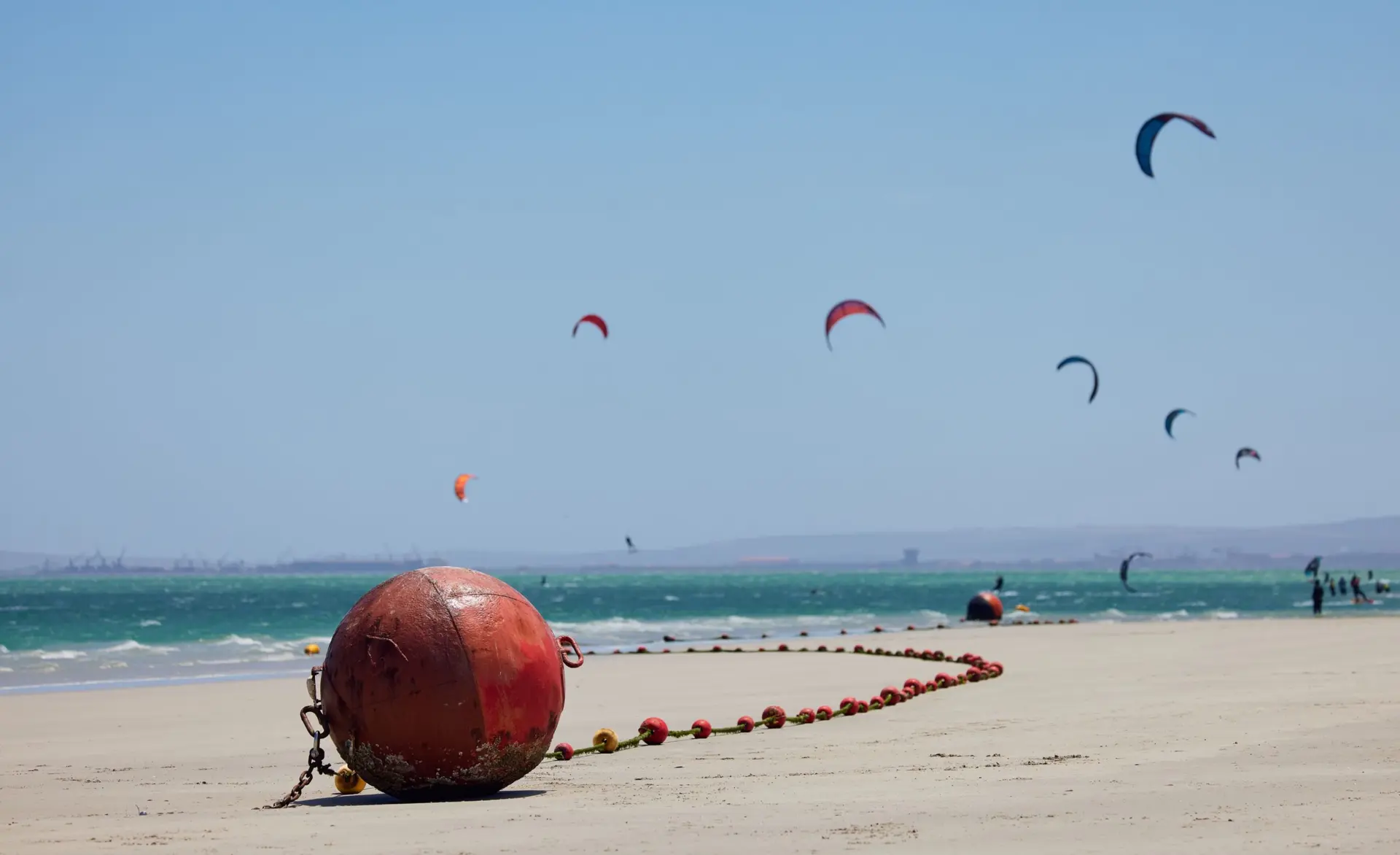
kitesurf, wingfoil and windsurf spots in South Africa
A southeasterly so reliable it is called the "Cape Doctor", a turquoise lagoon inside a national park, Table Mountain as a backdrop: every southern summer, South Africa becomes the meeting point of the global board sports scene.
222 spots listed, across 6 regions. Rideable days are computed from two full years of readings (2024 and 2025), spot by spot.
South Africa: an overview
The world's summer kite capital
When winter sets in over Europe, part of the kite world heads for Cape Town. From December to February, the city lives by a powerful, steady southeasterly, the "Cape Doctor", which sweeps the beaches of Bloubergstrand with rare consistency. You meet riders from all over the world, professionals in training and some of the most spectacular big air competitions on the circuit.
The image has become iconic: dozens of kites above the ocean and, behind them, the flat outline of Table Mountain. But South Africa is more than this postcard. The wilder west coast offers lagoons and fishing villages; the south coast and the east of the country, some of the most famous waves in the world.
Two oceans
The country is bordered by two very different oceans. In the west, the Atlantic is icy, cooled by a current from the Antarctic: the water stays cold even in midsummer, and the swell is powerful. In the east, the Indian Ocean is much warmer, and the coast is world-famous for its surf.
Conditions for confident riders
South African wind is generous, often strong and sometimes gusty, and many spots suit riders who are at ease. The lagoons, on the other hand, offer flat, sheltered water where you can learn and progress safely.
The best regions
Cape Town and Bloubergstrand
The country's most famous scene. Long white sand beaches, a view of Table Mountain and a powerful summer southeasterly. The starting point of almost every trip.
The West Coast
North of Cape Town, a wild coast of fishing villages, lagoons and estuaries. Quieter, more unspoilt, and ideal for flat water.
The Cape Peninsula
South of the city, cliffs, wave beaches and grand landscapes all the way to the Cape of Good Hope. Territory for experienced riders.
The Overberg and Hermanus
On the south coast, bays, lagoons and the world capital of whale watching.
The Eastern Cape
The wave coast, around Jeffreys Bay and St Francis. Warmer water and a legendary surf culture.
By region
The spots not to miss
-
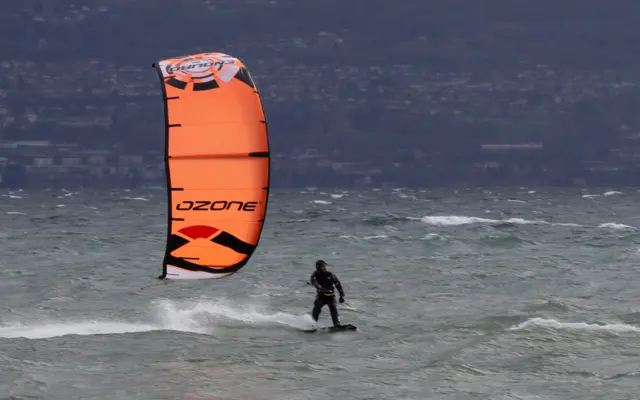
Paternoster (West Coast)
Western Cape
A fishing village of whitewashed cottages, famous for its crayfish. Well-shaped waves, best left to experienced riders when the southeasterly blows hard.
-
Velddrift (West Coast)
Cap-Occidental
The Berg River estuary, its salt pans and its flamingos. Flat, sheltered water, far from the big Atlantic beaches.
-
Langebaan (West Coast)
Western Cape
A turquoise, shallow, reliably windy lagoon inside the West Coast National Park. One of the best learning and freestyle spots in the country, an hour and a half from Cape Town.
-
Big Bay, Bloubergstrand (Cape Town)
Western Cape
A large bay north of Bloubergstrand, taken over by surfers in the morning and kiters in the afternoon. Waves, powerful wind and a view of Table Mountain.
-
Dolphin Beach, Bloubergstrand (Cape Town)
Western Cape
The beach with the most famous view of Table Mountain. Shore break, waves and strong wind: one of the most iconic images in board sports.
-
Witsands (Cape Peninsula)
Cap-Occidental
On the peninsula's wild coast, a renowned wave and freestyle spot, with very powerful swells in winter. For experienced riders, among cliffs and fynbos.
-
Hermanus Lagoon (Overberg)
Cap-Occidental
On Walker Bay, the whale-watching capital, a sheltered lagoon between the sea and the mountains. Calm water and superb scenery.
-
Cape St Francis (Eastern Cape)
Eastern Cape
A surf village of white houses, between dunes and reefs. Indian Ocean waves, warmer water and a peaceful atmosphere.
-
Jeffreys Bay (Eastern Cape)
Eastern Cape
One of the world's surf capitals, famous for waves peeling for hundreds of metres. Here, board sports meet surf culture at its most legendary.
When to ride
2024-2025 average| Region | J | F | M | A | M | J | J | A | S | O | N | D |
|---|---|---|---|---|---|---|---|---|---|---|---|---|
| Western Cape 85 | 20 | 19 | 19 | 17 | 8 | 6 | 6 | 8 | 17 | 20 | 24 | 21 |
| KwaZulu-Natal 43 | 21 | 18 | 22 | 13 | 13 | 11 | 12 | 18 | 15 | 17 | 16 | 21 |
| Eastern Cape 35 | 23 | 20 | 22 | 17 | 14 | 10 | 12 | 18 | 21 | 23 | 23 | 24 |
| Cap-Occidental 28 | 19 | 17 | 17 | 16 | 7 | 6 | 5 | 5 | 15 | 18 | 23 | 19 |
| Cap oriental 18 | 21 | 18 | 20 | 16 | 16 | 13 | 16 | 20 | 21 | 21 | 21 | 22 |
| Mpumalanga 4 | 9 | 8 | 8 | 11 | 5 | 10 | 17 | 19 | 20 | 17 | 18 | 19 |
| Free State 2 | 11 | 13 | 11 | 13 | 4 | 11 | 15 | 16 | 19 | 17 | 20 | 21 |
| État-Libre 1 | 24 | 22 | 20 | 18 | 18 | 20 | 30 | 27 | 24 | 21 | 23 | 26 |
The windiest spots
2024-2025 average| Spot | Region | Rideable days |
|---|---|---|
| bluewater bay | Eastern Cape | 321 d/yr |
| Bluewater Bay | Eastern Cape | 321 d/yr |
| Albatross | Eastern Cape | 306 d/yr |
| Jeffreys Bay | Eastern Cape | 306 d/yr |
| Cape St Francis | Eastern Cape | 299 d/yr |
| Langebaan | — | 299 d/yr |
| Aston Bay Beach | Eastern Cape | 298 d/yr |
| Kitchen Windows | Eastern Cape | 298 d/yr |
| Paradise Beach | Cap oriental | 298 d/yr |
| Pelican Island | KwaZulu-Natal | 290 d/yr |
Average rideable days per year, computed from 2024-2025 readings. A day counts as rideable when it has at least two consecutive hours of wind at 7 knots or more, blowing from a direction that works for the spot.
Good to know
- Season: the southeasterly is most consistent in the southern summer, from December to February. Winter brings cold fronts, bigger waves and less constant wind.
- Cold water in the west: on the Atlantic coast, the water stays cold all year. A thick wetsuit is needed, even in midsummer. The Indian Ocean, in the east, is milder.
- Powerful wind: the wind is often strong and sometimes gusty. Pack small kites and choose your spot according to your level.
- Marine wildlife: sharks are present along these coasts. Monitoring programmes operate on several Cape Town beaches; follow their advice.
- Parks and reserves: Langebaan Lagoon is part of a national park, with designated riding zones.
- Beach car parks: never leave valuables visible in your car.
All spots
222 spots-
 Paradise Beach - Marina Drive
Eastern Cape
595 d/yr
Kitesurf · Wingfoil · Sea
-
Noncom
Cap oriental
503 d/yr
Surf · Kitesurf · Sea
-
Milnerton
Western Cape
341 d/yr
Kitesurf · Wingfoil · Sea
-
bluewater bay
Eastern Cape
321 d/yr
Windfoil · Paddle · Lake
-
Bluewater Bay
Eastern Cape
321 d/yr
Windfoil · Paddle · Lake
-
Albatross
Eastern Cape
306 d/yr
Surf · Kitesurf · Sea
-
Jeffreys Bay
Eastern Cape
306 d/yr
Surf · Kitesurf · Sea
-
Cape St Francis
Eastern Cape
299 d/yr
Surf · Kitesurf · Sea
-
Langebaan
Not found
299 d/yr
Kitesurf · Wingfoil · Lake
-
Aston Bay Beach
Eastern Cape
298 d/yr
Kitesurf · Wingfoil · Sea
-
Kitchen Windows
Eastern Cape
298 d/yr
Surf · Kitesurf · Sea
-
Paradise Beach
Cap oriental
298 d/yr
Kitesurf · Wingfoil · Sea
-
Pelican Island
KwaZulu-Natal
290 d/yr
Kitesurf · Wingfoil · Lake
-
Sundays River
Cap oriental
285 d/yr
Kitesurf · Wingfoil · Sea
-
Sterkfontein Dam
État-Libre
274 d/yr
Kitesurf · Wingfoil · Lake
-
Boneyards
Eastern Cape
271 d/yr
Surf · Kitesurf · Sea
-
Magna Tubes
Eastern Cape
271 d/yr
Surf · Kitesurf · Sea
-
Supertubes
Eastern Cape
271 d/yr
Surf · Kitesurf · Sea
-
The Point
Eastern Cape
271 d/yr
Surf · Kitesurf · Sea
-
Kleinzee
Northern Cape
266 d/yr
Kitesurf · Wingfoil · Sea
-
Gouritzmond
Western Cape
262 d/yr
Kitesurf · Wingfoil · Sea
-
Maitlands Beach
Cap oriental
254 d/yr
Kitesurf · Wingfoil · Sea
-
Fence
Cap oriental
252 d/yr
Kitesurf · Wingfoil · Sea
-
Noncom
Cap oriental
252 d/yr
Surf · Kitesurf · Sea
Sports, by number of spots
- Kitesurf 222
- Wingfoil 174
- Windsurf 115
- Surf 85
- Paddle 10
- Windfoil 10
- Sup foiling 1